 Translate
How Often Should Beginners Go to the Gym? A Science-Backed Guide to Frequency and Recovery
By John Smith Fitness · 2 min read
This post reflects the author's own views, not Meal & Muscle's — see our content policy for how claims here are handled.

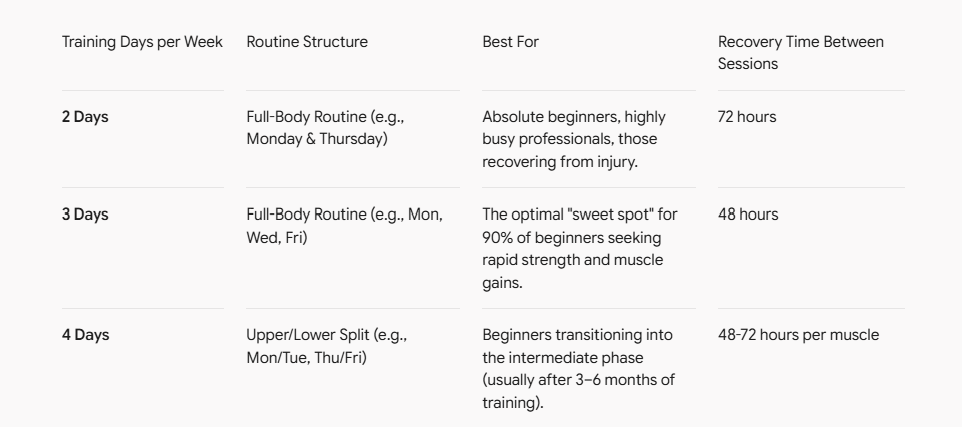
When you first decide to get in shape, the initial burst of motivation often tricks you into believing that more is better. You might think that training six days a week will get you to your goals twice as fast as training three days a week. From a physiological standpoint, however, this is one of the most counterproductive things a beginner can do. To understand why, we have to look at how the body actually builds muscle and cardiovascular endurance. The gym is not where you get stronger; the gym is where you create the stimulus for growth by breaking down muscle tissue and stressing your central nervous system (CNS). You actually get stronger while you are resting on the couch or sleeping, during a physiological process called supercompensation. When a complete beginner lifts weights or does intense cardio, the body experiences a high degree of neuromuscular shock. Because your nervous system is not yet efficient at firing muscle fibers, it takes a massive toll on your body to complete even a basic workout. If you go back to the gym before your body has fully recovered from this shock, you interrupt the supercompensation process. This leads to chronic systemic fatigue, severe Delayed Onset Muscle Soreness (DOMS), and ultimately, burnout or injury. The Evidence-Based Starting Point The American College of Sports Medicine (ACSM), along with decades of sports science research, recommends that beginners engage in resistance training 2 to 3 days per week on non-consecutive days, alongside 150 minutes of moderate steady-state cardio scattered throughout the week.
How to Structure Your Week If you choose the optimal 3-day full-body approach, your week should be balanced between mechanical tension (lifting weights) and active recovery (light movement that promotes blood flow without causing fatigue). Monday: Full-Body Resistance Training (Focus on compound movements) Tuesday: Active Recovery (30-minute brisk walk, mobility work, or light cycling) Wednesday: Full-Body Resistance Training Thursday: Active Recovery or Complete Rest Friday: Full-Body Resistance Training Weekend: Complete rest from structured exercise. Engage in light hobbies like hiking or swimming.
The 6-Week Rule Commit to this 3-day frequency for at least six weeks. During this window, your central nervous system will undergo rapid adaptations. You will notice that you are less sore after workouts and that your coordination has improved drastically. Only after this 6-week foundational period should you consider increasing your training frequency to four days a week.
Comments (2)
Log in or create an account to comment.

Highlighting total weekly set volume over individual workout length is crucial for beginners! Spreading 10–12 quality working sets per muscle group across 3 full-body sessions usually yields far better recovery and technique practice than annihilating a single muscle once a week on a bro split. Great breakdown!
Very imformative